
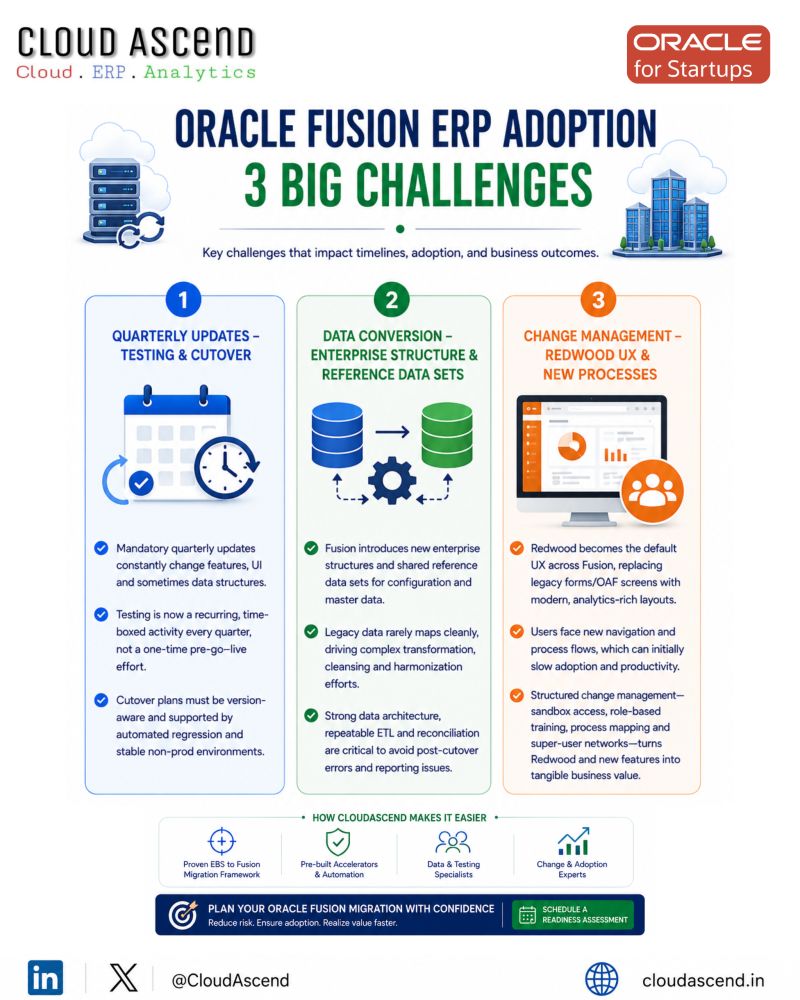
Moving to Oracle Fusion is more than a technology upgrade; it's an enterprise transformation
While organizations often focus on data migration, the biggest challenges usually extend beyond moving data from Oracle EBS to Oracle Fusion.
Three areas consistently determine the success of a Fusion implementation:
✅• Quarterly Updates, Testing & Cutover
Oracle Fusion's continuous update cycle means testing becomes an ongoing discipline, not a one-time project activity.
✅• Data Conversion & Enterprise Structure
Legacy data rarely fits directly into Fusion's enterprise structures. Data transformation, reconciliation, and governance are essential for a successful migration.
✅• Change Management & Redwood UX
New user experiences, redesigned business processes, and modern navigation require structured adoption, role-based training, and effective change management.
Organizations that address these challenges early are better positioned to reduce project risk, accelerate adoption, and achieve a smoother go-live.
At CloudAscend, we help enterprises and Oracle implementation partners simplify Oracle EBS to Oracle Fusion migrations with automation, pre-built accelerators, and proven migration frameworks.
Which of these challenges has had the biggest impact on your Oracle Fusion journey?
Share your experience in the comments; we'd love to hear your perspective.
Read full article here -> Linkedin
Request a demo
See Conversion Workbench on your own Oracle EBS data
Tell us a little about your Oracle EBS environment and migration timeline. We'll walk you through a live conversion cycle—no generic slideware, just your data and our workbench.
Typical response time: within 1 business day.
Cloud Ascend
Cloud Ascend helps enterprises and Oracle implementation partners accelerate Oracle Fusion adoption through migration intelligence, assessment automation and conversion automation.
Our platform enables organizations to reduce Oracle migration complexity, standardize data
conversion processes and improve implementation predictability.
Helping organizations migrate faster, with greater confidence and lower delivery risk.