
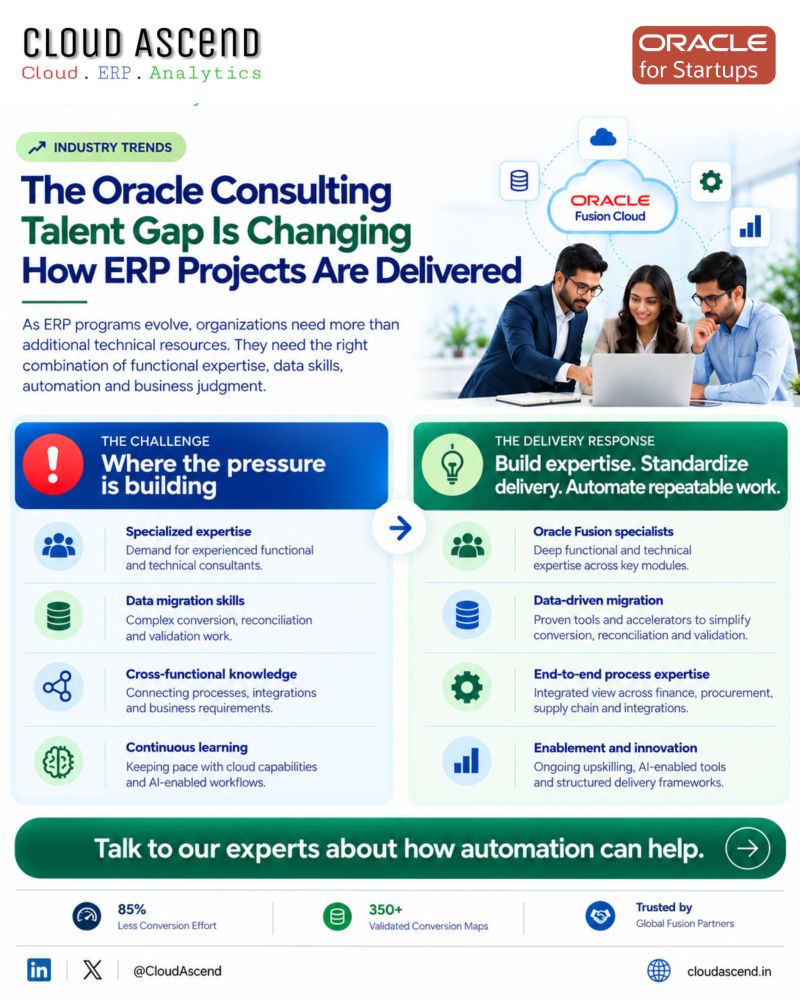
The talent gap in Oracle consulting is more than a hiring challenge. It's a delivery-model challenge.
As organizations evaluate Oracle EBS → Fusion migration and broader ERP modernization, consulting teams need a combination of functional expertise, technical skills, data migration experience and business-process knowledge.
The challenge is not simply finding more people. It is ensuring that the right expertise is available at the right stage of a complex transformation.
Four areas deserve attention:
→ Specialized expertise: Translating business requirements into effective ERP solutions.
→ Data Migration Skills: Managing mapping, conversion, reconciliation and validation.
→ Cross-Functional knowledge: Connecting finance, procurement, supply chain, integrations and governance.
→ Continuous Learning: Adapting to evolving cloud capabilities, AI and automation.
How can consulting firms respond?
Invest in skills development, capture knowledge in reusable assets, standardize recurring delivery activities and automate repetitive work where appropriate.
Automation does not eliminate the need for experienced consultants. It can give them more capacity to focus on exceptions, business decisions, quality and outcomes.
The opportunity is to build consulting teams that combine deep domain expertise with more repeatable, scalable delivery.
What skills do you think will be most important for the next generation of Oracle consultants?
Read full article here -> Linkedin
Request a demo
See Conversion Workbench on your own Oracle EBS data
Tell us a little about your Oracle EBS environment and migration timeline. We'll walk you through a live conversion cycle—no generic slideware, just your data and our workbench.
Typical response time: within 1 business day.
Cloud Ascend
Cloud Ascend helps enterprises and Oracle implementation partners accelerate Oracle Fusion adoption through migration intelligence, assessment automation and conversion automation.
Our platform enables organizations to reduce Oracle migration complexity, standardize data
conversion processes and improve implementation predictability.
Helping organizations migrate faster, with greater confidence and lower delivery risk.